

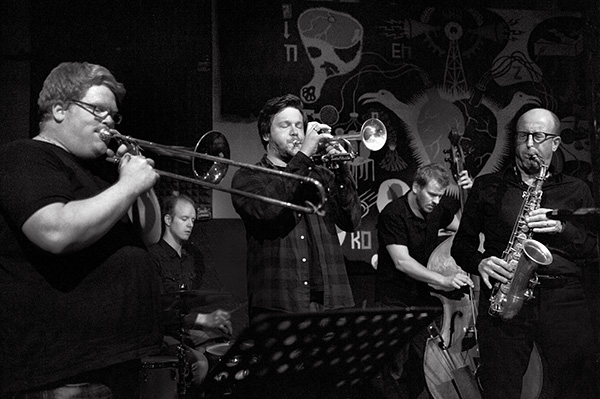
The quintet All Included founded by Swedish saxophonist Martin Küchen brings together members of the most important groups on Scandinavian contemporary jazz scene (Angels, Cortex, Universal Indians, Friends & Neighbors, Trespass Trio, Trondheim Jazz Orchestra…) into real all-star band. This joint effort connects stylistic extremes: tradicional jazz, with blues harmony and collective improvisations, as well as individual free playing in the manner of Ornette Coleman with meandering beyond conventional limits and frequent changes of tempo. Over the impulses of funky, swing or cut up rhythm of Norwegian bass player Jon Rune Strøm and drummer Tollef Østvang, trumpet player Tomas Johansson and Swedish tromponist Matts Aleklint are intensely outplaying with Küchen.
So far, this bend released two albums Reincarnation of a Lovebird (2012) and Satan in Plain Clothes (2015), thus expressing in equal measure the passion towards intense and lyrical ambience, obsessive groove and complex structures.
All Included will play at Belgrade Jazz Festival tonight (00:30) in Dom omladine Beograda (Belgrade Youth Center)
Your quintet consists of members with notably experience in other projects – tell us how you have gathered in All Included. What was the essential creative sparkle between you as artist individuals?
Tollef Østvang: Me, Jon Rune Strøm and Martin Küchen played as a trio back in 2009 mainly working in a freely improvised context. We wanted to bring compositions in and mix it with our freely improvised interplay, and involving two additional horn players was a natural step in that direction. We invited Mats Äleklint and Thomas Johansson to join into a quintet. Martin and Mats had worked a lot together for years, and me, Jon Rune and Thomas had been playing together for a while as well. So in 2010 the Swedish and the Norwegian fractions teamed up to form All Included.
Your second album is called “Satan in plain clothes” – can you tell us what the title refers to? How would you compare it to first band album in terms of music expression, but also from the perspective of you as musicians who are some years now playing and creating music together?
Tollef Østvang: I think you have to ask Martin Küchen regarding the true meaning behind that title since he wrote the composition. But it obviously indicates a general lack of trust in society. Things in life are rarely what they present themselves to be. We want our music to be honest and raw. Our goal is to execute spontaneous collective improvisation even within given forms such as written melodies, harmonies and rhythm.
I feel that our second album reflects that we have been on the road for some years. We have been lucky to get to tour in thirteen different countries together. The band sound hopefully comes out as more compact then before. Even though the first album had more freely improvised parts, the second album states a more relaxed and flexible way of playing together. It feels like we more easy can float inn and out of melodies, harmonies and rhythms then before. A more unified group of musicians in many ways. But that said, I think our first album had a very nice edge to it since each one of us was pulling things in a lot of different directions. I mean, we still do, but our almost kind of “traditional jazz” way of thinking of interplay are much more clear on our latest album. We all have a lot of “old school” references when it comes to how our instruments sounds, but also when it comes to how we interact with each other.
On “Satan in plain clothes” you are bringing together stylistic extremes: traditional jazz, with blues harmony and collective improvisations, as well as individually liberated playing and frequent changes of tempo. Tell us something more about the creative process of making it, and the inner spirit you are sharing with your audience through this album.
Tollef Østvang: I really appreciate the “everything can happen”- mentality we have in this group. A way of thinking about improvisation that brings references back to Art Ensemble of Chicago and others. Our mix of compositions and free improvisation can also be said to have clear reference to that part of the history. Often freely improvised settings can end up quite strict, or conceptual. It´s nothing wrong with that, but in this group it feels like we all want the music to potentially have a very broad stylistic outcome. We don’t always choose to take advantage of that, but the fact that we know everything is accepted within this group gives a funny twist and nerve to our live performance. I feel like a bird in a cage if I have to many “does and don’t” hanging over me. That counts both technically, musically and aesthetically. In this band we try to have none.
You have the opportunity to work with improvisers throughout Europe and the USA- could you compare these two jazz scenes?
Tollef Østvang: Well, “we play who we are”, and who we are partly reflects where we come from. It would make little sense for me to try to be someone I´m not. Or “to play someone I´m not”. That fact is what troubles me most when it comes to jazz education. Here I think Scandinavian jazz education have really understood something essential, that also explains parts of the next question. But that said, the world is getting smaller every day, and everything is just a big bowl of music and noise. But anyway, it´s hard and perhaps wrong to draw conclusions on how people play and sound based on what continent they come from, but historically you could of course look at differences between so called American free jazz and European improvised music with it´s different schools, and how that whole transcendence happened. As a young musician today I can relate to so many forms of music and expressions. We´re exposed to everything constantly. That´s both heaven and hell.
There is something specific in the Scandinavian jazz scene, and its unique artistic expression and emotional vibe it brings to audience. What would be yours description and definition of it?
Tollef Østvang: The fact that Scandinavian jazz education have been, and still is, a pioneer compared to jazz education worldwide with its strong focus on individual expression and aural training, is one of the keys to the Scandinavian sound in my point of view. Specially the jazz department in Trondheim where I live and have studied. It has existed since 1979. From day one the students learn that “why” is just as important as “how”. It´s no point of producing a bunch of perfectly skilled instrumentalists that don’t know why they are musicians. In Trondheim the teachers relate to the students as colleagues and fellow human beings instead of masters creating small copies of themselves. The most important thing a teacher learns his students is to ask right and critical questions. That is questions we need to ask our self for the rest of our life to be able to move forward. Both as human beings and as musicians.
You could of course look at key points in Scandinavian jazz such as Jan Garbarek, Bobo Stenson and the whole influence of ECM to explain the Scandinavian sound, but if you ask me it gives much more meaning to basically look at Scandinavian society with its politics and social democracy as an answer to why there is a lot of interesting things going on.
This year’s slogan of the Belgrade Jazz Festival is “Planet Jazz” – do you think that jazz around the world is the same, universal language of music, or are there differences? How do you see and feel jazz in 21st century?
Tollef Østvang: I say music is music, and it´s definitively universal. There are differences, but that is what makes it exiting and beautiful. It would be terribly boring if everybody sounded the same. Sadly, there is already too much music that sounds exactly the same. Usually that is a result of the need of labeling things into familiar categories and genres. My mantra is, If I manage to stay clear of those labels and categories that people too often put on top of our heads, it means that I´m doing something right. As David Bowie said: “It´s terrible dangerously for an artist to fulfill other people´s expectations. I think they generally produce their worst work when they do that”
What do you know about Belgrade and Serbia? Are you familiar with some jazz (or other) musicians from our country?
Tollef Østvang: Two years ago we played at Kanjiza Jazz Festival with All Included. That was my first visit to Serbia. Earlier this year I visited Belgrade for the first time when I played at the RingRing festival in May with Joe McPhee and Universal Indians. Both where great experiences due to a very listening and welcoming audience. I don’t know too many Serbian musicians yet, but I studied together with saxophone player Luka Ignjatovic at Conservatorium van Amsterdam in Amsterdam back in 2011. He is also playing at this year’s festival. Looking very much forward to hear his concert. It´s also a Serbian composer and accordion player that lives in Trondheim where I live. His name is Jovan Pavlovic. Great musicians. I will stay two extra days in Belgrade, so I hope to get to hear and get to know more musicians.
What program will you play for the audience at the Belgrade Jazz Festival?
Tollef Østvang: A combination of the material on our two albums, and maybe some brand new stuff, or and wherever the moment takes us.